Hjalmar Borgstrøm
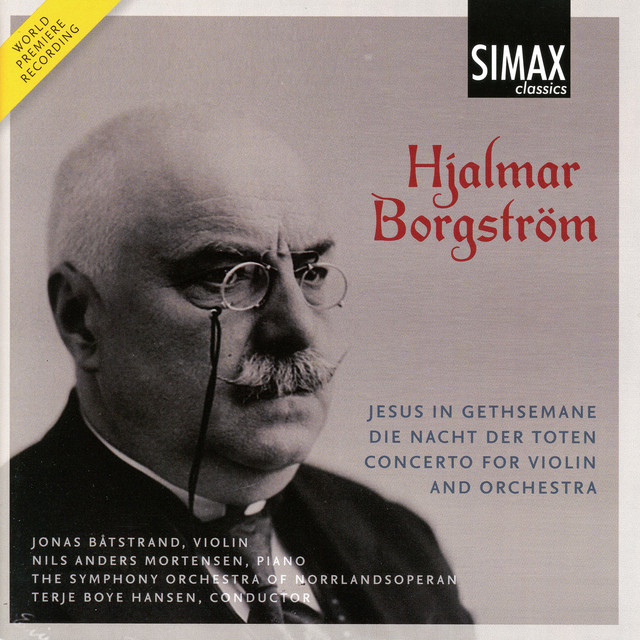
Despite criticism from Edvard Grieg that his works were insufficiently nationalistic, the music of Hjalmar Borgstrøm was widely performed in the early 20th century. Borgstrøm was also a well-known music critic in Norway. Although his music went into decline after his death, the 21st century has seen a renewal of interest in his career, with his two operas being performed for the first time. Various orchestral works by Borgstrøm have been recorded, and the Trondheim Symphony Orchestra issued an album of his symphonic poems in 2024.
Borgstrøm was born Hjalmar Jensen on March 23, 1864, in Kristiania, Norway (now Oslo). His father was a government official, and both parents were enthusiastic amateur musicians who recognized their son's talent. He took piano and violin lessons and was skilled on both instruments by his mid-teens. He began composition and theory lessons with the composers Johan Svendsen (from 1881 to 1883), Ludvig Mathias Lindeman (around 1883), and Ole Olsen (1883 to 1887), and then spent two years studying in Leipzig, Germany. On returning to Norway, he discovered that there was another composer named Hjalmar Jensen and officially began using his mother's maiden name. In 1890, Borgstrøm had some success with a cantata, Hvæm er du med de tusene navne ("Who Are You with a Thousand Names"), but he decided to return to Germany for further study and ended up spending 13 years there. He became friends with Ferruccio Busoni and admired the music of Wagner, who influenced his own music strongly.
Back in Norway in 1903, Borgstrøm had further success with Hamlet, a programmatic piano concerto. The soloist was Amalie Müller, and she and Borgstrøm married the following year. Although Edvard Grieg had complained that his music lacked Norwegian elements, Borgstrøm became fairly successful in Norway with symphonic poems such as The Night of the Dead (1905) and other large works. He also composed 45 songs. Borgstrøm's wife died in 1913, after which his compositional output slowed. Beginning in 1913, he served as the music critic for the Oslo daily Aftenposten. He died in Oslo on July 5, 1925. His music was performed during the interwar period but then fell into obscurity. The 21st century saw a revival of interest in Borgstrøm's work, and his two operas -- Thora paa Rimol ("Thora of Rimol") and Fiskeren ("The Fisherman") -- were produced for the first time in 2002 and 2003 respectively. By the mid-2020s, at least a dozen of Borgstrøm's compositions had been recorded. ~ James Manheim, Rovi
More Info