Nancy Dalberg
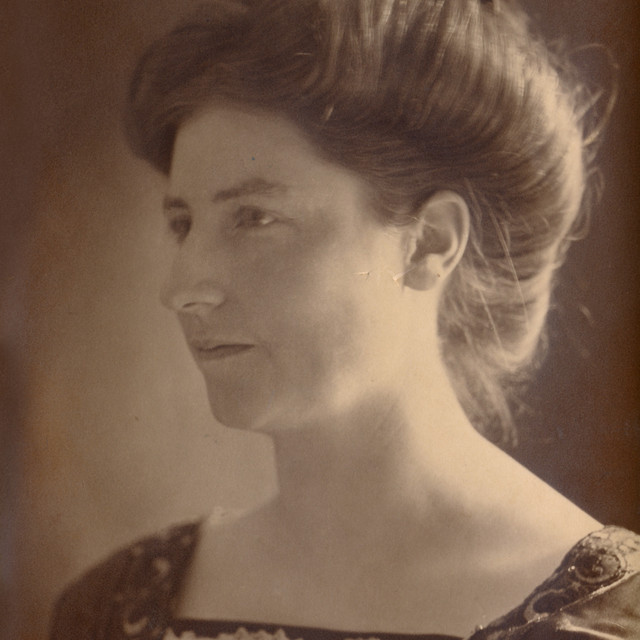
Nancy Dalberg (1881-949) was born as the daughter of a highly successful businessman, meaning that she grew up in a family with no lack of financial resources. At the age of 20 she married the engineering officer and portrait painter Erik Dalberg. She received piano lessons and studied composition with the Norwegian composer Johan Svendsen. She was presumably also a student of the composer Fini Henriques before becoming a student of the most prominent Danish musician of the time, Carl Nielsen. Dalberg and Nielsen developed a clos professional relationship, and Nielsen conducted or participated in the performance of several of her works. He also asked her to help orchestrate his works Aladdin and Springtime on Funen.
Dalberg had her first string quartet was performed – with Carl Nielsen on violin – in 1914, but her true public debut came in 1915 when she held a concert in Copenhagen, with only her works on the programme. Later also her string quartets, songs, and several orchestral works – most notably the symphony – were performed. Generally, Dalberg’s music was well received, but critics rarely failed to comment on her gender, often surprised that a woman was able to compose so well.
Stylistically, Dalberg moved from the late romantic and into the modern. In her music, one finds both sweeping, romantic melodies and short, repetitive motifs. The latter feature was often criticized by contemporary critics but can also be heard as a modern quality in Dalberg’s music.
More Info